
Run the whole factory from one system.
Production, stock, sales, purchasing, finance and payroll in one system built around how your floor actually works. Everyone logs in once, and the numbers you make decisions on are live.
- Modules
- 16
- Features
- 226
- Login
- 1

- Stock lives in three spreadsheetsNobody knows what is really in the store until someone walks over and counts.
- Orders arrive on WhatsAppThey get lost somewhere between sales, the floor and dispatch.
- Costing is a guessYou know what a batch sold for, not what it actually cost to make.
- Month end takes a weekInvoices, M-Pesa and bank statements matched by hand, line by line.
Your factory deserves better.
PMS, ERP and CRM. One login.
Production, quality, maintenance, stock, purchasing, sales, dispatch, finance and payroll on one database, so an order taken by sales reaches the floor, the store and the books without being typed twice. Click around the dashboard below: it is set up as a demo food plant in Ruiru.
Try it: open a module from the menu, click a record, filter the list, or press New order and save.
- Production
- Supply chain
- Sales
- Finance
- People
No records match.
New dashboard
No records match.
Line 2, maize milling · Shifts A and B · Released 5 Oct 2026
- Product
- Maize meal 2 kg, recipe MM2-R4
- Made for
- Stock, and SO-26-2231 Kamau Wholesalers
- Planned
- 24,000 packs, 48.0 t
- Done so far
- 15,360 packs, 30.7 t
- Maize issued
- 39.1 t from batch RM-2609-114
- Yield to standard
- 99.6% (tolerance 98%)
- By-products
- Bran 5.8 t, germ 1.9 t
- Due
- Wed 7 Oct, 18:00
- Pallets 12 to 16 booked into finished goods, 7,680 packs
- Moisture check passed at 12.8% by Faith Wanjiru
- Milling started on Line 2, crew of Peter Otieno
- Maize and packing film issued by stores, 39.1 t and 24 rolls
- Order released from the week 41 plan by Grace Muthoni
New order
No records match.
Version 7 · Approved 14 Sep 2026 · Batch size 2,000 kg
- Main ingredient
- Maize, Grade 1, 2,560 kg per batch
- Premix
- Vitamin and mineral, 200 g per tonne
- Packing
- 2 kg printed film, bale sleeve of 12
- Milling yield
- 78% meal, 16% bran, 6% germ
- Moisture loss
- 1.5% allowed at conditioning
- Allergens
- None declared
- Standard cost
- KES 59.20 per kg, KES 118.40 per pack
- Approved by
- Peter Ndirangu, QA lead
- Cost per pack updated to KES 118.40 after maize price change
- Version 7 approved by Peter Ndirangu, v6 retired
- Trial batch PO-26-0352 passed moisture and sieve tests
- Premix dose changed from 180 g to 200 g per tonne
New recipe
No records match.
Week 41, 5 to 10 October 2026 · Two shifts, 06:00 to 22:00
- Capacity
- 16 hours a day, 62 t a day
- Planned
- 350 t in 6 orders
- Load
- 94% after changeovers
- Changeover
- Wed 22:00, 2 kg to 1 kg, 45 min
- Maize needed
- 448 t, 391 t in stock
- Open LPOs
- LPO-26-0617, 120 t, due Thu 8 Oct
- Planner
- Grace Muthoni
- PO-26-0420 moved from Thursday to Wednesday night shift
- Plan against actual: Monday 61.9 t made against 62 t planned
- Week 41 plan approved by Janet Wairimu, operations manager
- Material needs run: 57 t of maize to buy by Thursday
Release orders
No records match.
Maize meal 2 kg · Line 2 · Made 6 Oct 2026, Shift A
- Production order
- PO-26-0418
- Test
- Moisture, oven method
- Sample
- 3 packs from pallet 14
- Reading
- 12.9% (limit 13.5%)
- Checked by
- Faith Wanjiru, QA technician
- Other checks today
- Premix pass, net weight pass, sieve pass
- Batch status
- Released for sale 6 Oct, 15:10
- Batch MM-261006-A released by Peter Ndirangu, QA lead
- Certificate of analysis CoA-26-0612 produced
- Net weight check: 20 packs, average 2,006 g, no outliers
- Moisture 12.9% recorded on tablet at Line 2
- Batch opened on hold when milling started
Record check
No records match.
Hammer mill 2 · Line 2, maize milling · Planned, every 400 hours
- Trigger
- 400 running hours, reached 5 Oct
- Technician
- Dennis Kiprono
- Parts used
- Screen 3 mm x1, beater bolts x8
- Parts cost
- KES 38,600 from engineering store
- Labour
- 2.5 hours
- Downtime
- 2 h 40 min, during changeover
- Signed off by
- Moses Wekesa, mill supervisor
- Next service
- At 4,800 hours, about 29 Oct
- Signed off by Moses Wekesa, mill back on line
- Test run, 15 minutes, no vibration above limit
- Screen and beater bolts issued from the engineering store
- Work order opened when running hours reached 4,400
New work order
No records match.
Raw material · Code RM-0101 · Bought in tonnes, issued in kilos
- On hand
- 412.6 t in Silo 2
- Reserved
- 86.4 t for PO-26-0418 and PO-26-0420
- Available
- 326.2 t
- On order
- 120 t on LPO-26-0617, due 8 Oct
- Average cost
- KES 41,850 per tonne
- Value
- KES 17,267,310
- Last count
- 30 Sep, variance 0.4%, approved
- Oldest batch
- RM-2609-102, received 12 Sep
- 39.1 t issued to PO-26-0418 from batch RM-2609-114
- GRN-2212: 96.0 t received from Rift Valley Grain Traders
- Stock take: counted 375.2 t against 376.7 t, variance approved
- Average cost updated to KES 41,850 per tonne
Adjust stock
No records match.
Maize meal 2 kg · Line 2, Shift A · 7,680 packs, 640 bales
- Production order
- PO-26-0418
- Maize lot
- GRN-2212, Rift Valley Grain Traders
- Premix lot
- GRN-2190, lot VP-0826
- Film lot
- GRN-2203, roll batch LF-4471
- QA release
- 6 Oct, 15:10, Peter Ndirangu
- Certificate
- CoA-26-0612
- Dispatched
- 220 bales on 3 orders
- In stock
- 420 bales, Finished goods bay 4
- 220 bales loaded on KCX 418L for Kamau Wholesalers, SO-26-2231
- Released by QA, moved from hold to available
- 640 bales booked into finished goods, bay 4
- Batch opened on PO-26-0418 from maize lot GRN-2212
Trace a batch
No records match.
White maize, grade 1 · Raised 15 Sep 2026 · Terms 30 days
- Requisition
- PR-26-0402 from the week 38 plan
- Approved by
- Daniel Kiprop, 16 Sep
- Price
- KES 47,000 per tonne, grade 1
- Received
- 59.4 t on 2 GRNs
- Deductions
- 0.6 t for moisture above 13.5%
- Supplier bill
- INV-KGG-1182, KES 2,791,800
- Three-way match
- LPO, GRNs and bill agree
- Payment
- Due 29 Oct, in the payment run
- Bill INV-KGG-1182 matched to LPO and GRNs, approved for payment
- GRN-2205: 31.4 t received at the weighbridge, moisture 13.9%
- GRN-2198: 28.0 t received, aflatoxin 4.1 ppb, accepted
- LPO approved by Daniel Kiprop and emailed to the supplier as a PDF
New LPO
No records match.
Wholesaler · Thika route · Customer since March 2022 · KRA PIN on file
- Contact
- James Kamau, 0722 *** 904
- Rep
- Brian Ochieng, visits Tuesdays
- Price list
- Wholesale, October
- Credit
- KES 1,500,000 limit, 30 days
- Balance
- KES 812,400, nothing overdue
- Buys
- Maize meal 2 kg, porridge flour 1 kg
- Target
- KES 1,300,000 a month, 95% reached
- Last order
- SO-26-2231, on the road 7 Oct
- SO-26-2231 loaded on KCX 418L, 220 bales, SMS sent to James Kamau
- Visit by Brian Ochieng: shelf check, order taken for 220 bales
- Payment of KES 640,000 received by bank transfer
- Complaint CC-0139 closed: 4 torn bales credited
New lead
No records match.
Distributor price list · Mombasa territory · Valid to 20 Oct 2026
- Contact
- Hassan Mwinyi, 0733 *** 562
- Rep
- Brian Ochieng
- Lines
- Maize meal 2 kg 1,200 bales, 1 kg 600 bales
- Discount
- 3% volume, within rep limit
- Delivery
- Transporter, KES 3,400 per tonne
- Value
- KES 2,460,000 before VAT
- Margin
- 18.2%, floor 15%
- Version
- 2 of 2, delivery price revised
- Customer opened the quote link and asked for 30-day terms
- Version 2 sent by WhatsApp as a PDF with a link to accept
- Version 1 sent by Brian Ochieng after the Mombasa visit
- Lead moved to negotiating after a sample order
New quote
No records match.
Customer LPO 448210 · Thika route · Load KCX 418L, drop 2 of 6
- Lines
- Maize meal 2 kg, 220 bales
- Batch picked
- MM-261006-A, best before 06 Apr 2027
- Value
- KES 369,600
- Credit check
- Passed, KES 687,600 left on limit
- Driver
- Joseph Kariuki, 0721 *** 336
- Delivery note
- DN-26-4418, gate pass GP-2210
- Due
- Wed 7 Oct, 09:40
- Left the gate, gate pass GP-2210 checked by security
- Loaded and checked: 220 bales, 5.3 t, batch MM-261006-A
- Pick list printed for bay 4, first expiry first
- Order taken by Brian Ochieng at the customer's shop
New sales order
No records match.
September 2026 · 17 batches on Lines 1 and 2 · 825.6 t packed
- Revenue
- KES 59,689,000 before VAT
- Standard cost
- KES 118.40 per pack
- Actual cost
- KES 119.20 per pack
- Maize price effect
- Plus KES 1.10, maize up KES 430 a tonne
- Usage and yield
- Minus KES 0.30, yield 78.4% against 78%
- Labour
- KES 3.60 per pack from approved time sheets
- Overheads
- KES 6.90 per pack, by machine hours
- Bran and germ credit
- Minus KES 8.20 per pack
- September costing closed by Esther Achieng, finance manager
- Overheads of KES 8.1 million spread by machine hours
- Job time sheets for September approved, 6,412 hours
- Last September batch MM-260930-B closed and costed
Run costing
No records match.
From delivery note DN-26-4371 · SO-26-2207 · Terms 30 days
- Customer
- Kamau Wholesalers, PIN on file
- Lines
- Maize meal 2 kg 200 bales, 1 kg 60 bales
- Amount
- KES 486,000
- eTIMS
- Validated 28 Sep, KRA number on the PDF
- Paid
- KES 486,000 by paybill, 6 Oct
- M-Pesa receipt
- UJ6P2K8QTB, account INV-26-1187
- Rep
- Brian Ochieng
- KES 486,000 paid by paybill and matched to this invoice
- Receipt sent to James Kamau by SMS and email
- Reminder sent by SMS, due in 2 days
- Invoice issued from DN-26-4371 and validated on eTIMS
New invoice
No records match.
Current account ending 4471 · September 2026 · Period locked
- Statement balance
- KES 18,240,500 at 30 Sep
- Lines on statement
- 1,284, all matched
- Matched by rules
- 1,233 (96%)
- Matched by hand
- 51, each with a note
- Payment runs
- 4 in September, KES 31.2 million
- Reconciled by
- Esther Achieng, 2 Oct
- Reviewed by
- Daniel Kiprop, 3 Oct
- Reconciliation reviewed and September period locked
- Last 51 lines matched by hand by Esther Achieng
- September statement imported, 1,233 lines matched by rules
- Payment run PAY-26-039 sent to the bank as a file, 46 suppliers
New journal
No records match.
Shift A, 06:00 to 14:00 · Tuesday 6 October 2026 · Lines 1 and 2
- Supervisor
- Moses Wekesa
- Crew
- 16 permanent, 8 casuals
- Clocked in
- 22 on time, 2 late (06:14, 06:22)
- On leave
- 2, covered by casuals from the pool
- Overtime yesterday
- 18 hours, approved by Moses Wekesa
- Medical certificates
- 1 expires 20 Oct, Peter Otieno
- Shift B
- 22 booked, 14:00 to 22:00
- Last clock-in: Joseph Maina, 22 minutes late, noted
- 8 casuals confirmed by SMS and clocked in at the gate
- 18 overtime hours from Monday approved for payroll
- Roster for week 41 published to the crew by SMS
Add casuals
No records match.
September 2026 · 168 permanent staff · Paid 30 Sep 2026
- Gross pay
- KES 9,840,000
- Overtime included
- 1,312 hours, KES 412,600
- Statutory deductions
- KES 1,854,100 (PAYE, SHA, NSSF, levy)
- Loans and SACCO
- KES 859,500
- Net pay
- KES 7,126,400
- Paid by
- Bank file 161, M-Pesa B2C 7
- Approved by
- Esther Achieng, then Daniel Kiprop
- Payslips
- 168 sent by SMS link, 152 opened
- Bank confirmed all 161 transfers, 7 M-Pesa payments completed
- 168 payslips sent by SMS link
- Second approval by Daniel Kiprop, bank file released
- First approval by Esther Achieng after the variance check
- Payroll run from September attendance and approved overtime
Run payroll
Dashboard
Output, orders, stock and cash on one screen: the first thing the operations manager opens each morning.
Production orders
Every production order from release to finished goods, with a digital job card for each batch.
- Orders from sales or stock levelsRaise production orders by hand, from confirmed sales orders, or when finished goods fall below their minimum.
- Digital job cardsEach batch gets a job card with its recipe, stages, machines and checks, opened on a tablet on the floor.
- Material issue against the orderStores issue raw and packing materials to the order, and the system shows what is still to be issued.
- Stage-by-stage progressOperators mark each stage started and finished, so the board shows where every batch is right now.
- Output and by-productsGood output, by-products such as bran and germ, and rejects recorded in kilos and in packs.
- Yield and wastage per batchActual yield against the recipe standard, with a reason required for any loss above tolerance.
- Partial completionsFinished goods booked into stock as pallets come off the line, not only when the order closes.
- Labour and machine timeHours booked per stage by crew and machine, feeding the actual cost of the batch.
- Rework and re-runsA failed batch goes back for rework on its own job card, linked to the original order.
- Close and cost the orderOn closing, materials, labour and overheads roll into a cost per kilo and per pack.
- Production boardA live board for the floor screen: orders by line and stage, with late jobs highlighted.
Recipes & BOMs
Recipes and bills of materials with versions, scaling and the packing each pack needs.
- Multi-level bills of materialsFinished packs built from blends and semi-finished items, each with its own recipe.
- Recipes by batch sizeQuantities scale from a base batch to any size, rounded to the units stores actually issue.
- Packing materials per productFilm, jars, lids, labels, bales and cartons per pack, so packing stock is planned too.
- Versions and approvalEvery change creates a new version that QA approves before it can be used on the floor.
- Substitute ingredientsApproved alternatives, such as a second sorghum grade, with the ratio and the effect on cost.
- Standard yields and lossesExpected moisture loss, milling yield and by-products set per recipe and per stage.
- Fortification premixPremix dosage per tonne kept on the recipe and checked against what stores actually issued.
- Allergens and nutritionAllergens such as groundnuts and soya flagged, with nutrition values kept for the label.
- Recipe cost roll-upStandard cost per kilo and per pack from current ingredient prices, updated as prices change.
- Where-used searchFind every recipe that uses an ingredient before you change a supplier or a specification.
Production planning
A weekly production plan from orders and forecasts, with the materials and line time to back it.
- Plan from orders and forecastsThe weekly plan is built from confirmed orders, distributor forecasts and minimum stock levels.
- Material requirements (MRP)The plan is run through the recipes to show what to buy and by when, net of stock and open LPOs.
- Capacity per lineHours and tonnes per line and shift, so the plan cannot load a line beyond what it can run.
- Drag-and-drop scheduleMove orders between lines and days on a calendar, and material dates recalculate.
- Changeovers and cleaningSet-up and cleaning time between products is added, so the schedule groups similar runs.
- Shortage warningsOrders that will run short of a material or packing item are flagged before they reach the floor.
- Promise dates for salesSales see when a new order can be made and shipped before they confirm it to the customer.
- Plan against actualPlanned and actual output compared daily for each line, with the reason for any gap.
- Scenario copiesCopy the plan to test a large order or a machine stoppage without touching the live schedule.
Quality control
Checks at intake, on the line and before release, with holds and certificates tied to each batch.
- Intake inspectionMoisture, aflatoxin, foreign matter and grade recorded for every grain delivery before it is accepted.
- In-process checksChecklists per stage and product, filled in on a tablet at set intervals by the line operator.
- Specifications with limitsEach test has a target and limits; a reading outside them turns red and alerts QA at once.
- Batch hold and releaseFinished goods stay on hold until QA releases them, and held stock cannot be picked or sold.
- Lab resultsLab tests such as protein, fat and microbiology entered against the batch, with the report attached.
- Non-conformance reportsProblems logged with cause, action and owner, and closed only when the action is verified.
- Customer complaintsEach complaint linked to its batch, the batch tests and the customer's other deliveries.
- Certificates of analysisA certificate per batch produced from the results, ready to send with the delivery.
- Hygiene and cleaning recordsCleaning schedules and pest control visits signed off by line and shift, ready for audits.
- Pack weight controlPack weights sampled from the line against the declared net weight, with averages and outliers.
- Supplier quality scoresRejection rates per supplier feed into purchasing and the supplier scorecard.
Maintenance
Machine register, downtime and planned maintenance, so breakdowns become the exception.
- Machine registerEvery machine with its make, serial number, location, manuals and full service history.
- Planned maintenanceService tasks scheduled by days, running hours or tonnes processed, each with a checklist.
- Breakdown reportsOperators report a fault from the floor tablet with a photo, and the technician is alerted at once.
- Work ordersEach job records the fault, the fix, parts used, hours spent and who signed it off.
- Downtime logEvery stoppage timed and coded, such as breakdown, changeover, power cut or no material.
- OEE per lineAvailability, performance and quality worked out per line and shift from the floor data.
- Spare parts storeSpares in the engineering store with minimum levels, linked to the machines they fit.
- Power, water and fuelMeter readings logged per shift, to show utility cost per tonne produced.
- Contractor visitsOutside technicians logged with their job, time on site and invoice.
- Calibration recordsScales, moisture meters and thermometers with calibration due dates and certificates.
Inventory & stores
Raw materials, packing and finished goods across every store, counted once and valued live.
- Stores, silos and binsGrain silos, the raw material store, packing store, finished goods and depots, each with its own bins.
- Units and conversionsBuy in tonnes, issue in kilos, sell in packs and bales, with conversions set once per item.
- Reorder levels and alertsMinimum, reorder point and lead time per item, with alerts to purchasing by email and SMS.
- Transfers between storesTransfer notes signed by sender and receiver, with stock in transit shown until it arrives.
- Barcode and QR labelsPallet and bin labels printed from the system and scanned with a phone to move or count stock.
- Cycle counts and stock takesCounts by store or bin on a phone, with variances approved before stock is adjusted.
- Stock valuationWeighted average or FIFO cost, with the value of each store at any date.
- Adjustments with reasonsDamage, spillage and write-offs need a reason and an approver, and post to the books.
- Movement historyEvery receipt, issue, transfer and sale with who, when and the document behind it.
- Slow and dead stockItems with no movement in 60 or 90 days listed with their value.
- Reserved and availableStock committed to orders shown apart from stock that is free to sell.
Batch traceability
Lot numbers from grain delivery to the customer's shelf, with expiry dates and recall lists in minutes.
- Lot numbers at intakeEvery delivery gets a lot number linked to the supplier, vehicle, GRN and intake tests.
- Batch numbers on outputFinished batches numbered by product, date and shift, and printed on packs and bale labels.
- Forward and backward tracingFrom a raw material lot to every customer who received it, or from a pack back to its grain.
- Best-before datesDates set from the shelf life of each product, with stock nearing expiry flagged for sale or return.
- First expiry, first outDispatch is told which batch to pick first by expiry, and warned if it picks another.
- Recall listsA recall report lists the affected batches, quantities, stock left and every customer by delivery.
- Mock recall drillsRun a test recall and time it, with the report kept for audits.
- Batch genealogyWhich lots of maize, soya and premix went into each finished batch, and in what amounts.
- QuarantineHeld or returned batches moved to quarantine, where they cannot be issued or sold.
Purchasing
Requests, approvals, LPOs, goods received and supplier bills, matched three ways before anyone pays.
- Purchase requisitionsStores, production or engineering raise a request, or the weekly plan raises one when stock will run short.
- Approval limitsApprovers set by amount and department, and requests approved from a phone with the budget shown.
- Requests for quotationSend one RFQ to several suppliers and compare prices, terms and lead times side by side.
- LPOs sent from the systemLocal purchase orders emailed to the supplier as a PDF, with your terms and delivery address.
- Goods received notesDeliveries received against the LPO at the gate, with weighbridge weight and quality checks.
- Grain bought by weight and gradePrice per kilo adjusted for moisture and grade, with every deduction shown on the GRN.
- Landed costsFreight, duty and clearing on imported premix and packing spread over the items, so stock carries its true cost.
- Received, not yet billedGoods received without a supplier bill listed with their value, so month-end accruals are right.
- Three-way matchEach supplier bill is checked against its LPO and GRN before it can be approved for payment.
- Supplier register and scorecardContacts, KRA PIN, bank details and terms per supplier, with on-time delivery and rejection rates.
- Price historyEvery price paid per item and supplier, to see what grain and packing really cost through the year.
- Supplier paymentsApproved bills paid in a bank payment run, or by M-Pesa for smaller grain suppliers, with remittance advice sent.
CRM & leads
Every distributor, retailer and institution with their contacts, visits, deals and history.
- Customer accountsDistributors, wholesalers, retailers and institutions with contacts, KRA PIN, terms and price list.
- Lead captureLeads from the website, WhatsApp, calls and trade fairs land in one list with their source.
- Pipeline by stageDeals move from lead to sample to trial order to regular customer, with value and expected date.
- Rep visitsReps check in at outlets on their phone with location, notes, photos and the next action.
- Routes and territoriesCustomers grouped by route and territory, with each rep's visit plan for the week.
- Follow-up remindersTasks and reminders so that no quote, sample or call-back is forgotten.
- Samples and tastingsSamples handed out recorded by product and outlet, then followed up for an order.
- Customer timelineCalls, visits, quotes, orders, invoices, payments and complaints on one page.
- Targets per repMonthly volume and value targets by rep, route and product, with progress shown daily.
- WhatsApp and SMS from the recordSend a message from the customer page and keep a copy on their timeline.
Quotes & price lists
Price lists per channel, discounts with limits, and quotes that become orders in one click.
- Price lists per channelSeparate prices for distributors, wholesalers, retailers and institutions, and by region if needed.
- Dated price changesNew prices set with an effective date, approved, and sent to customers before they apply.
- Volume and tier discountsDiscounts by quantity or order value, applied automatically on quotes and orders.
- Discount limits by roleReps discount up to a set limit, and anything beyond goes to the sales manager to approve.
- Quote builderPick the customer, products and quantities; prices, VAT and delivery come from the system.
- Branded PDF quotesQuotes sent by email or WhatsApp as a PDF with your logo, terms and validity date.
- Accept by linkEach quote has a private link where the customer reads it and accepts it, and you see when it was opened.
- Duplicate, revise and importCopy a quote for another customer, keep each revision as a version, or import lines from a spreadsheet.
- Quote to orderAn accepted quote becomes a sales order without retyping, with stock checked at once.
- PromotionsTime-bound offers such as a free pack per bale, with the cost tracked against each promotion.
- Margin check on quotesThe rep sees the margin on each line, with a warning when it falls below the floor you set.
- VAT per itemStandard-rated, zero-rated and exempt items handled correctly on the same quote and invoice.
Orders & dispatch
From sales order to signed delivery note, with stock reserved, loads planned and customers told.
- Sales orders from any channelOrders entered by reps, the office or the distributor portal, or copied from a quote.
- Credit check on entryOrders from customers over their limit or with overdue invoices are held for approval.
- Stock reservationConfirmed orders reserve stock, or raise a production order when there is not enough.
- Pick lists by batchPick lists by store and bin, showing the batch to take first by expiry.
- Load planningOrders grouped into loads by route and vehicle, with weight checked against the vehicle's capacity.
- Own fleet and transportersUse your own trucks or hired transporters, with the cost of each trip recorded.
- Delivery notes and gate passesPrinted or sent to the driver's phone, and checked by security at the gate.
- Proof of deliveryThe customer signs on the driver's phone, and the photo, time and location are saved on the order.
- Short deliveries and returnsShortages, damage and returns recorded at delivery and credited correctly.
- Customer updatesSMS or WhatsApp when the order is confirmed, loaded and delivered.
- Back ordersLines that could not be filled stay open and are offered on the next load.
Costing & margins
What each batch, product and customer really costs and earns, worked out from the floor data.
- Actual cost per batchMaterials at their real cost, labour hours, machine time and overheads for every batch.
- Labour from job time sheetsHours booked per job and approved by the supervisor flow into the cost of each batch.
- Standard against actualEach batch compared with its standard cost, with the variance split into price, usage and yield.
- Waste recorded per jobSpillage, rejects and sweepings weighed per job, so their cost shows instead of hiding in the yield.
- Overhead allocationPower, fuel, rent and supervision spread by machine hours, tonnes or labour, as you choose.
- Cost per tonne, kilo and packCosts shown in the unit each team uses: per tonne milled, per kilo, per pack and per bale.
- Margin by productRevenue, cost and gross margin per product, by month and by channel.
- Margin by customerDiscounts, promotions, returns and delivery costs taken off to show what each customer earns you.
- By-product creditsBran and germ sales credited back against the cost of the main product.
- Price change simulatorSee what a rise in maize or film prices does to cost and margin before it arrives.
- Landed costFreight, duty and clearing added to imported items such as premix and packing film.
Invoicing & eTIMS
Invoices, credit notes and statements validated on KRA eTIMS, with M-Pesa and bank payments matched.
- Invoice from the deliveryDelivered quantities become the invoice, so customers are billed for what they signed for.
- KRA eTIMS validationEach invoice and credit note sent to eTIMS as it is issued, with the KRA invoice number and QR code printed.
- Credit notesReturns, short deliveries and price corrections credited against the original invoice, also on eTIMS.
- Paybill and STK pushCustomers pay to the paybill with the invoice number, or get an STK push from the invoice itself.
- Automatic matchingM-Pesa and bank receipts matched to customers and invoices, with anything unclear sent to a short review list.
- Customer statementsStatements by email or WhatsApp on a schedule, or on request from the customer page.
- Debtor ageingBalances by 30, 60, 90 and over 90 days, per customer, rep and route.
- Payment remindersPolite reminders by SMS and email before and after the due date, stopped once the invoice is paid.
- Credit limits and holdsA limit per customer, with new orders held automatically when the account is over limit or overdue.
- Withholding VAT certificatesWithholding VAT deducted by customers recorded against the invoice, with the certificate attached.
Accounts & banking
Double-entry books kept by the system as work happens, ready for tax returns, audits and the board.
- Chart of accounts for a factoryRaw materials, work in progress, finished goods and cost of sales set up from the start.
- Automatic journalsReceipts, issues, production, sales, payroll and payments post to the ledger as they happen.
- Bank and M-Pesa reconciliationBank and M-Pesa statements imported and matched, leaving only the exceptions to clear.
- Payment runs and bank filesApproved supplier bills grouped into a run, paid by bank file, with remittance advice sent to each supplier.
- Customer and supplier ledgersReceivables and payables, with ageing, that always agree with the general ledger.
- VAT and withholding reportsSales and purchase listings and withholding VAT schedules in the formats iTax accepts.
- Expenses and petty cashExpense claims and petty cash with photographed receipts and recorded approvals.
- Fixed assetsMachines, vehicles and buildings, with depreciation run every month.
- LoansEquipment and working capital loans with drawdowns, repayments and interest posted on schedule.
- Budgets by departmentBudgets for production, sales and administration, with actuals shown against them each month.
- Month-end closeA checklist for the close, with each period locked once the accounts are signed off.
- Financial statementsProfit and loss, balance sheet and cash flow at any date, by plant or department.
Shifts & attendance
Rosters, clock-in and overtime for permanent staff and casuals, feeding straight into payroll.
- Shift rostersDay and night shifts per line, with crews assigned and swaps approved by the supervisor.
- Biometric or phone clock-inFingerprint or face terminals at the gate, or phone clock-in with location for drivers and reps.
- Casual workersCasuals registered with ID and phone number, booked by the day and paid on the daily rate.
- Overtime rulesOvertime and public holiday hours worked out from the clock times and approved before payroll.
- Leave and absenceLeave requests and approvals on the phone, with balances and a calendar per department.
- Headcount per lineWho is on each line right now, against the crew size the plan needs.
- Short shift alertsSupervisors alerted when a shift is short, so they can call in a replacement in time.
- Recruitment and onboardingVacancies, candidates, interviews and offers, then an onboarding checklist and probation review.
- Discipline and noticesWarnings and hearings recorded on the staff file, and notices sent to a line or the whole plant.
- Medical certificates and trainingFood handler medical certificates and training records with expiry dates and reminders.
- Staff filesContracts, IDs, next of kin, warnings and documents kept for each employee.
Payroll
Monthly and casual payrolls with the statutory deductions worked out, and pay sent by bank or M-Pesa.
- Monthly payrollBasic pay, allowances, overtime and deductions taken from attendance, approved in two steps.
- Casual payrollCasuals paid daily or weekly from their attendance, with the deductions that apply to them.
- Statutory deductionsPAYE, SHA, NSSF and the Affordable Housing Levy worked out at the current rates.
- Returns ready to filePAYE, SHA, NSSF, Housing Levy and NITA files produced each month in the formats the portals accept.
- Bonuses and commissionsProduction bonuses and sales commissions calculated from the period's figures and added to the run.
- Loans and advancesSalary advances and staff debts deducted on schedule, with the balance shown on the payslip.
- SACCO and union deductionsDeductions for staff SACCOs, unions and welfare groups, with remittance lists.
- Pay by bank or M-PesaNet pay sent as a bank file or by M-Pesa B2C, with each payment tracked to the end.
- Payslips on the phonePayslips sent by SMS link or email, and kept on each employee's self-service page.
- P9 formsYear-end P9 tax cards for every employee, produced from the year's payrolls.
- Labour cost by lineWages and overtime charged to each line and order, so costing uses the real labour cost.
Want this for your factory? Let us build yours.
We walk you through it on a call, map how your factory works, and send a fixed-scope proposal in writing.
Custom built, not off the shelf. Every system we build is made to fit the client's needs: the modules, screens, wording and reports follow how your organisation works. The business, names and figures in this demo are examples.
Every batch, tracked as it runs.
Every production order from release to finished goods, with a digital job card for each batch.
- Orders from sales or stock levels
- Digital job cards
- Material issue against the order
Know what a batch really cost.
What each batch, product and customer really costs and earns, worked out from the floor data.
- Actual cost per batch
- Labour from job time sheets
- Standard against actual
From order to delivery note.
From sales order to signed delivery note, with stock reserved, loads planned and customers told.
- Sales orders from any channel
- Credit check on entry
- Stock reservation
From order to cash.
One order moves through sales, the floor, quality, dispatch and finance without being typed twice. Each step is recorded against the order, so anyone can see where it is.
-
01
Order in
A distributor orders on the portal or a rep on the phone, and credit and stock are checked at once.
-
02
Plan
Anything short becomes a production order, slotted into the plan with its materials reserved.
-
03
Make
The batch runs on a tablet job card that records output, yield, labour and machine time.
-
04
Check and release
QA tests the batch against its specification and releases it. Held stock cannot be sold.
-
05
Dispatch
Picked by expiry, loaded by route and signed for on the driver's phone.
-
06
Invoice & collect
The invoice goes through eTIMS, the customer pays by M-Pesa or bank, and the payment is matched.
Everyone sees their part.
Directors get the whole picture, the floor gets job cards, and your distributors get their own login to check stock, prices and orders without calling you.
For directors, supervisors and distributors.
Wired into how business runs here.
STK push on invoices, and paybill payments matched to the right customer automatically.
Every invoice validated as it is issued, with the receipt number stored on the sale.
PAYE, SHA, NSSF and the Housing Levy calculated each month, with the returns ready to file.
Order updates, low-stock alerts and payslips go out on the channels people actually read.
Exports for QuickBooks, Zoho Books or Sage if your auditors prefer them.
Every screen works on the phones and tablets your team already carries.
Choose a connection to see what it does.
Built for manufacturers and live.
Timeless Timber runs its hardwood production and stock on a system we built and host, with procurement, finance and HR being added to it. Prestige Industrial sells a catalogue of more than 19,000 parts through a store we built.
 Timeless Timber PMSProduction system
Production, kiln stages, stock and dispatch for a Nairobi hardwood company.
timelesstimber.ke
Timeless Timber PMSProduction system
Production, kiln stages, stock and dispatch for a Nairobi hardwood company.
timelesstimber.ke
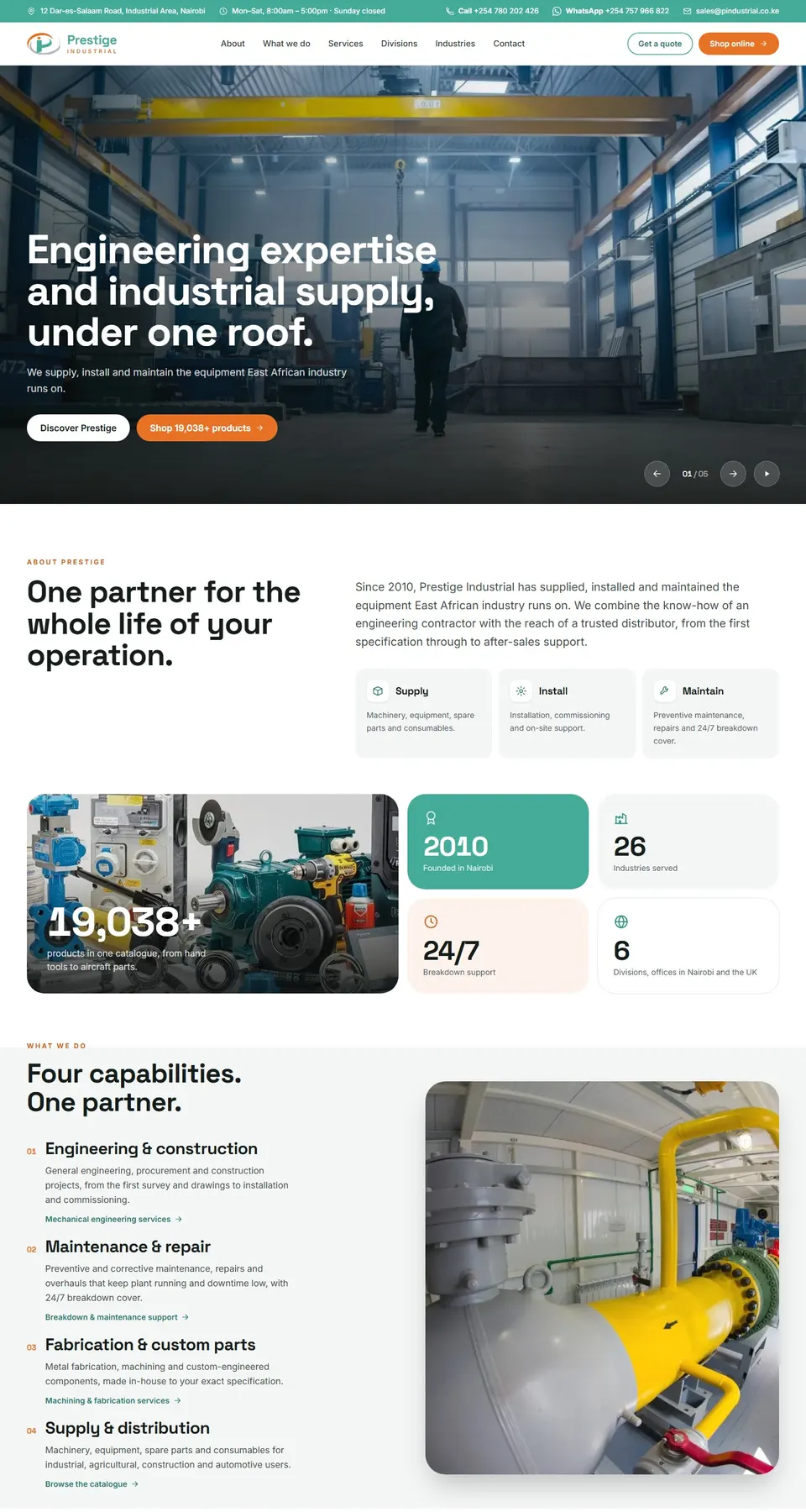 Prestige IndustrialIndustrial store
Engineering services and a 19,000-part industrial catalogue with quotes and online orders.
pindustrial.co.ke
Prestige IndustrialIndustrial store
Engineering services and a 19,000-part industrial catalogue with quotes and online orders.
pindustrial.co.ke
 Garrett AfricaDistributor store
Official Garrett detector distributor for Kenya, Zambia and Tanzania, with catalogue and dealer sales.
garrett.africa
Garrett AfricaDistributor store
Official Garrett detector distributor for Kenya, Zambia and Tanzania, with catalogue and dealer sales.
garrett.africa
 Case study · Industrial & B2B
Garrett Africa
Digital expansion and distributor enablement for the world’s leading metal detection brand.
300%Increase in organic traffic65New distributor pipelines opened#1Ranking for "Gold Detector Africa"
Read the case study
Case study · Industrial & B2B
Garrett Africa
Digital expansion and distributor enablement for the world’s leading metal detection brand.
300%Increase in organic traffic65New distributor pipelines opened#1Ranking for "Gold Detector Africa"
Read the case study

226 features. 24 areas, one system.
Every feature in Pinch for Manufacturing, grouped by area. Pick an area, or search for the thing you need.
Production orders
Every production order from release to finished goods, with a digital job card for each batch.
- Orders from sales or stock levelsRaise production orders by hand, from confirmed sales orders, or when finished goods fall below their minimum.
- Digital job cardsEach batch gets a job card with its recipe, stages, machines and checks, opened on a tablet on the floor.
- Material issue against the orderStores issue raw and packing materials to the order, and the system shows what is still to be issued.
- Stage-by-stage progressOperators mark each stage started and finished, so the board shows where every batch is right now.
- Output and by-productsGood output, by-products such as bran and germ, and rejects recorded in kilos and in packs.
- Yield and wastage per batchActual yield against the recipe standard, with a reason required for any loss above tolerance.
- Partial completionsFinished goods booked into stock as pallets come off the line, not only when the order closes.
- Labour and machine timeHours booked per stage by crew and machine, feeding the actual cost of the batch.
- Rework and re-runsA failed batch goes back for rework on its own job card, linked to the original order.
- Close and cost the orderOn closing, materials, labour and overheads roll into a cost per kilo and per pack.
- Production boardA live board for the floor screen: orders by line and stage, with late jobs highlighted.
Recipes & BOMs
Recipes and bills of materials with versions, scaling and the packing each pack needs.
- Multi-level bills of materialsFinished packs built from blends and semi-finished items, each with its own recipe.
- Recipes by batch sizeQuantities scale from a base batch to any size, rounded to the units stores actually issue.
- Packing materials per productFilm, jars, lids, labels, bales and cartons per pack, so packing stock is planned too.
- Versions and approvalEvery change creates a new version that QA approves before it can be used on the floor.
- Substitute ingredientsApproved alternatives, such as a second sorghum grade, with the ratio and the effect on cost.
- Standard yields and lossesExpected moisture loss, milling yield and by-products set per recipe and per stage.
- Fortification premixPremix dosage per tonne kept on the recipe and checked against what stores actually issued.
- Allergens and nutritionAllergens such as groundnuts and soya flagged, with nutrition values kept for the label.
- Recipe cost roll-upStandard cost per kilo and per pack from current ingredient prices, updated as prices change.
- Where-used searchFind every recipe that uses an ingredient before you change a supplier or a specification.
Production planning
A weekly production plan from orders and forecasts, with the materials and line time to back it.
- Plan from orders and forecastsThe weekly plan is built from confirmed orders, distributor forecasts and minimum stock levels.
- Material requirements (MRP)The plan is run through the recipes to show what to buy and by when, net of stock and open LPOs.
- Capacity per lineHours and tonnes per line and shift, so the plan cannot load a line beyond what it can run.
- Drag-and-drop scheduleMove orders between lines and days on a calendar, and material dates recalculate.
- Changeovers and cleaningSet-up and cleaning time between products is added, so the schedule groups similar runs.
- Shortage warningsOrders that will run short of a material or packing item are flagged before they reach the floor.
- Promise dates for salesSales see when a new order can be made and shipped before they confirm it to the customer.
- Plan against actualPlanned and actual output compared daily for each line, with the reason for any gap.
- Scenario copiesCopy the plan to test a large order or a machine stoppage without touching the live schedule.
Quality control
Checks at intake, on the line and before release, with holds and certificates tied to each batch.
- Intake inspectionMoisture, aflatoxin, foreign matter and grade recorded for every grain delivery before it is accepted.
- In-process checksChecklists per stage and product, filled in on a tablet at set intervals by the line operator.
- Specifications with limitsEach test has a target and limits; a reading outside them turns red and alerts QA at once.
- Batch hold and releaseFinished goods stay on hold until QA releases them, and held stock cannot be picked or sold.
- Lab resultsLab tests such as protein, fat and microbiology entered against the batch, with the report attached.
- Non-conformance reportsProblems logged with cause, action and owner, and closed only when the action is verified.
- Customer complaintsEach complaint linked to its batch, the batch tests and the customer's other deliveries.
- Certificates of analysisA certificate per batch produced from the results, ready to send with the delivery.
- Hygiene and cleaning recordsCleaning schedules and pest control visits signed off by line and shift, ready for audits.
- Pack weight controlPack weights sampled from the line against the declared net weight, with averages and outliers.
- Supplier quality scoresRejection rates per supplier feed into purchasing and the supplier scorecard.
Maintenance
Machine register, downtime and planned maintenance, so breakdowns become the exception.
- Machine registerEvery machine with its make, serial number, location, manuals and full service history.
- Planned maintenanceService tasks scheduled by days, running hours or tonnes processed, each with a checklist.
- Breakdown reportsOperators report a fault from the floor tablet with a photo, and the technician is alerted at once.
- Work ordersEach job records the fault, the fix, parts used, hours spent and who signed it off.
- Downtime logEvery stoppage timed and coded, such as breakdown, changeover, power cut or no material.
- OEE per lineAvailability, performance and quality worked out per line and shift from the floor data.
- Spare parts storeSpares in the engineering store with minimum levels, linked to the machines they fit.
- Power, water and fuelMeter readings logged per shift, to show utility cost per tonne produced.
- Contractor visitsOutside technicians logged with their job, time on site and invoice.
- Calibration recordsScales, moisture meters and thermometers with calibration due dates and certificates.
Inventory & stores
Raw materials, packing and finished goods across every store, counted once and valued live.
- Stores, silos and binsGrain silos, the raw material store, packing store, finished goods and depots, each with its own bins.
- Units and conversionsBuy in tonnes, issue in kilos, sell in packs and bales, with conversions set once per item.
- Reorder levels and alertsMinimum, reorder point and lead time per item, with alerts to purchasing by email and SMS.
- Transfers between storesTransfer notes signed by sender and receiver, with stock in transit shown until it arrives.
- Barcode and QR labelsPallet and bin labels printed from the system and scanned with a phone to move or count stock.
- Cycle counts and stock takesCounts by store or bin on a phone, with variances approved before stock is adjusted.
- Stock valuationWeighted average or FIFO cost, with the value of each store at any date.
- Adjustments with reasonsDamage, spillage and write-offs need a reason and an approver, and post to the books.
- Movement historyEvery receipt, issue, transfer and sale with who, when and the document behind it.
- Slow and dead stockItems with no movement in 60 or 90 days listed with their value.
- Reserved and availableStock committed to orders shown apart from stock that is free to sell.
Batch traceability
Lot numbers from grain delivery to the customer's shelf, with expiry dates and recall lists in minutes.
- Lot numbers at intakeEvery delivery gets a lot number linked to the supplier, vehicle, GRN and intake tests.
- Batch numbers on outputFinished batches numbered by product, date and shift, and printed on packs and bale labels.
- Forward and backward tracingFrom a raw material lot to every customer who received it, or from a pack back to its grain.
- Best-before datesDates set from the shelf life of each product, with stock nearing expiry flagged for sale or return.
- First expiry, first outDispatch is told which batch to pick first by expiry, and warned if it picks another.
- Recall listsA recall report lists the affected batches, quantities, stock left and every customer by delivery.
- Mock recall drillsRun a test recall and time it, with the report kept for audits.
- Batch genealogyWhich lots of maize, soya and premix went into each finished batch, and in what amounts.
- QuarantineHeld or returned batches moved to quarantine, where they cannot be issued or sold.
Purchasing
Requests, approvals, LPOs, goods received and supplier bills, matched three ways before anyone pays.
- Purchase requisitionsStores, production or engineering raise a request, or the weekly plan raises one when stock will run short.
- Approval limitsApprovers set by amount and department, and requests approved from a phone with the budget shown.
- Requests for quotationSend one RFQ to several suppliers and compare prices, terms and lead times side by side.
- LPOs sent from the systemLocal purchase orders emailed to the supplier as a PDF, with your terms and delivery address.
- Goods received notesDeliveries received against the LPO at the gate, with weighbridge weight and quality checks.
- Grain bought by weight and gradePrice per kilo adjusted for moisture and grade, with every deduction shown on the GRN.
- Landed costsFreight, duty and clearing on imported premix and packing spread over the items, so stock carries its true cost.
- Received, not yet billedGoods received without a supplier bill listed with their value, so month-end accruals are right.
- Three-way matchEach supplier bill is checked against its LPO and GRN before it can be approved for payment.
- Supplier register and scorecardContacts, KRA PIN, bank details and terms per supplier, with on-time delivery and rejection rates.
- Price historyEvery price paid per item and supplier, to see what grain and packing really cost through the year.
- Supplier paymentsApproved bills paid in a bank payment run, or by M-Pesa for smaller grain suppliers, with remittance advice sent.
CRM & leads
Every distributor, retailer and institution with their contacts, visits, deals and history.
- Customer accountsDistributors, wholesalers, retailers and institutions with contacts, KRA PIN, terms and price list.
- Lead captureLeads from the website, WhatsApp, calls and trade fairs land in one list with their source.
- Pipeline by stageDeals move from lead to sample to trial order to regular customer, with value and expected date.
- Rep visitsReps check in at outlets on their phone with location, notes, photos and the next action.
- Routes and territoriesCustomers grouped by route and territory, with each rep's visit plan for the week.
- Follow-up remindersTasks and reminders so that no quote, sample or call-back is forgotten.
- Samples and tastingsSamples handed out recorded by product and outlet, then followed up for an order.
- Customer timelineCalls, visits, quotes, orders, invoices, payments and complaints on one page.
- Targets per repMonthly volume and value targets by rep, route and product, with progress shown daily.
- WhatsApp and SMS from the recordSend a message from the customer page and keep a copy on their timeline.
Quotes & price lists
Price lists per channel, discounts with limits, and quotes that become orders in one click.
- Price lists per channelSeparate prices for distributors, wholesalers, retailers and institutions, and by region if needed.
- Dated price changesNew prices set with an effective date, approved, and sent to customers before they apply.
- Volume and tier discountsDiscounts by quantity or order value, applied automatically on quotes and orders.
- Discount limits by roleReps discount up to a set limit, and anything beyond goes to the sales manager to approve.
- Quote builderPick the customer, products and quantities; prices, VAT and delivery come from the system.
- Branded PDF quotesQuotes sent by email or WhatsApp as a PDF with your logo, terms and validity date.
- Accept by linkEach quote has a private link where the customer reads it and accepts it, and you see when it was opened.
- Duplicate, revise and importCopy a quote for another customer, keep each revision as a version, or import lines from a spreadsheet.
- Quote to orderAn accepted quote becomes a sales order without retyping, with stock checked at once.
- PromotionsTime-bound offers such as a free pack per bale, with the cost tracked against each promotion.
- Margin check on quotesThe rep sees the margin on each line, with a warning when it falls below the floor you set.
- VAT per itemStandard-rated, zero-rated and exempt items handled correctly on the same quote and invoice.
Orders & dispatch
From sales order to signed delivery note, with stock reserved, loads planned and customers told.
- Sales orders from any channelOrders entered by reps, the office or the distributor portal, or copied from a quote.
- Credit check on entryOrders from customers over their limit or with overdue invoices are held for approval.
- Stock reservationConfirmed orders reserve stock, or raise a production order when there is not enough.
- Pick lists by batchPick lists by store and bin, showing the batch to take first by expiry.
- Load planningOrders grouped into loads by route and vehicle, with weight checked against the vehicle's capacity.
- Own fleet and transportersUse your own trucks or hired transporters, with the cost of each trip recorded.
- Delivery notes and gate passesPrinted or sent to the driver's phone, and checked by security at the gate.
- Proof of deliveryThe customer signs on the driver's phone, and the photo, time and location are saved on the order.
- Short deliveries and returnsShortages, damage and returns recorded at delivery and credited correctly.
- Customer updatesSMS or WhatsApp when the order is confirmed, loaded and delivered.
- Back ordersLines that could not be filled stay open and are offered on the next load.
Costing & margins
What each batch, product and customer really costs and earns, worked out from the floor data.
- Actual cost per batchMaterials at their real cost, labour hours, machine time and overheads for every batch.
- Labour from job time sheetsHours booked per job and approved by the supervisor flow into the cost of each batch.
- Standard against actualEach batch compared with its standard cost, with the variance split into price, usage and yield.
- Waste recorded per jobSpillage, rejects and sweepings weighed per job, so their cost shows instead of hiding in the yield.
- Overhead allocationPower, fuel, rent and supervision spread by machine hours, tonnes or labour, as you choose.
- Cost per tonne, kilo and packCosts shown in the unit each team uses: per tonne milled, per kilo, per pack and per bale.
- Margin by productRevenue, cost and gross margin per product, by month and by channel.
- Margin by customerDiscounts, promotions, returns and delivery costs taken off to show what each customer earns you.
- By-product creditsBran and germ sales credited back against the cost of the main product.
- Price change simulatorSee what a rise in maize or film prices does to cost and margin before it arrives.
- Landed costFreight, duty and clearing added to imported items such as premix and packing film.
Invoicing & eTIMS
Invoices, credit notes and statements validated on KRA eTIMS, with M-Pesa and bank payments matched.
- Invoice from the deliveryDelivered quantities become the invoice, so customers are billed for what they signed for.
- KRA eTIMS validationEach invoice and credit note sent to eTIMS as it is issued, with the KRA invoice number and QR code printed.
- Credit notesReturns, short deliveries and price corrections credited against the original invoice, also on eTIMS.
- Paybill and STK pushCustomers pay to the paybill with the invoice number, or get an STK push from the invoice itself.
- Automatic matchingM-Pesa and bank receipts matched to customers and invoices, with anything unclear sent to a short review list.
- Customer statementsStatements by email or WhatsApp on a schedule, or on request from the customer page.
- Debtor ageingBalances by 30, 60, 90 and over 90 days, per customer, rep and route.
- Payment remindersPolite reminders by SMS and email before and after the due date, stopped once the invoice is paid.
- Credit limits and holdsA limit per customer, with new orders held automatically when the account is over limit or overdue.
- Withholding VAT certificatesWithholding VAT deducted by customers recorded against the invoice, with the certificate attached.
Accounts & banking
Double-entry books kept by the system as work happens, ready for tax returns, audits and the board.
- Chart of accounts for a factoryRaw materials, work in progress, finished goods and cost of sales set up from the start.
- Automatic journalsReceipts, issues, production, sales, payroll and payments post to the ledger as they happen.
- Bank and M-Pesa reconciliationBank and M-Pesa statements imported and matched, leaving only the exceptions to clear.
- Payment runs and bank filesApproved supplier bills grouped into a run, paid by bank file, with remittance advice sent to each supplier.
- Customer and supplier ledgersReceivables and payables, with ageing, that always agree with the general ledger.
- VAT and withholding reportsSales and purchase listings and withholding VAT schedules in the formats iTax accepts.
- Expenses and petty cashExpense claims and petty cash with photographed receipts and recorded approvals.
- Fixed assetsMachines, vehicles and buildings, with depreciation run every month.
- LoansEquipment and working capital loans with drawdowns, repayments and interest posted on schedule.
- Budgets by departmentBudgets for production, sales and administration, with actuals shown against them each month.
- Month-end closeA checklist for the close, with each period locked once the accounts are signed off.
- Financial statementsProfit and loss, balance sheet and cash flow at any date, by plant or department.
Shifts & attendance
Rosters, clock-in and overtime for permanent staff and casuals, feeding straight into payroll.
- Shift rostersDay and night shifts per line, with crews assigned and swaps approved by the supervisor.
- Biometric or phone clock-inFingerprint or face terminals at the gate, or phone clock-in with location for drivers and reps.
- Casual workersCasuals registered with ID and phone number, booked by the day and paid on the daily rate.
- Overtime rulesOvertime and public holiday hours worked out from the clock times and approved before payroll.
- Leave and absenceLeave requests and approvals on the phone, with balances and a calendar per department.
- Headcount per lineWho is on each line right now, against the crew size the plan needs.
- Short shift alertsSupervisors alerted when a shift is short, so they can call in a replacement in time.
- Recruitment and onboardingVacancies, candidates, interviews and offers, then an onboarding checklist and probation review.
- Discipline and noticesWarnings and hearings recorded on the staff file, and notices sent to a line or the whole plant.
- Medical certificates and trainingFood handler medical certificates and training records with expiry dates and reminders.
- Staff filesContracts, IDs, next of kin, warnings and documents kept for each employee.
Payroll
Monthly and casual payrolls with the statutory deductions worked out, and pay sent by bank or M-Pesa.
- Monthly payrollBasic pay, allowances, overtime and deductions taken from attendance, approved in two steps.
- Casual payrollCasuals paid daily or weekly from their attendance, with the deductions that apply to them.
- Statutory deductionsPAYE, SHA, NSSF and the Affordable Housing Levy worked out at the current rates.
- Returns ready to filePAYE, SHA, NSSF, Housing Levy and NITA files produced each month in the formats the portals accept.
- Bonuses and commissionsProduction bonuses and sales commissions calculated from the period's figures and added to the run.
- Loans and advancesSalary advances and staff debts deducted on schedule, with the balance shown on the payslip.
- SACCO and union deductionsDeductions for staff SACCOs, unions and welfare groups, with remittance lists.
- Pay by bank or M-PesaNet pay sent as a bank file or by M-Pesa B2C, with each payment tracked to the end.
- Payslips on the phonePayslips sent by SMS link or email, and kept on each employee's self-service page.
- P9 formsYear-end P9 tax cards for every employee, produced from the year's payrolls.
- Labour cost by lineWages and overtime charged to each line and order, so costing uses the real labour cost.
Distributor & customer portal
Trade customers order, track and pay on their own login, without calling your office.
- Own login per customerEach distributor, wholesaler or institution signs in to see only their own account.
- Order from their price listCustomers order at their own prices and see what is available before they submit.
- Repeat an orderReorder a previous order in one tap and change the quantities.
- Order trackingStatus from confirmed to in production, loaded, on the road and delivered.
- Invoices and statementsInvoices, eTIMS receipts, credit notes and statements to view and download.
- Pay with M-PesaPay an invoice or the whole balance by STK push, and the payment is matched at once.
- Returns and complaintsRaise a return or a quality complaint with photos and the batch number from the pack.
- Logins for branchesA distributor adds logins for branches or staff, each with its own permissions.
Floor tablets & phones
Screens built for the floor, the store and the road, on the phones and tablets your team already has.
- Tablet job cardsLarge buttons and short steps, built for operators on a busy line.
- Scan to actScan a pallet, bin or batch label with the phone camera to receive, move, issue or count it.
- Works on a weak connectionEntries are saved on the device and sent when the network returns, so the floor never waits.
- Floor display screensThe production board and today's targets on a screen on the factory wall, updated live.
- Rep appReps see their route, visit customers, take orders and collect payments on their phone.
- Driver appDrivers see their drops, capture signatures and photos, and record returns.
- Manager viewOutput, orders, cash and alerts for directors on a phone, at any time.
Alerts & notifications
The right person hears about a problem while there is still time to fix it.
- Low stock alertsPurchasing alerted when a material or packing item reaches its reorder point.
- Quality failuresQA and the production manager alerted the moment a reading falls outside its limits.
- Machine breakdownsThe technician on duty gets an SMS as soon as an operator reports a fault.
- Approvals waitingApprovers reminded about requisitions, LPOs, discounts and payrolls waiting for them.
- Overdue customersReps told when one of their customers goes overdue or over their credit limit.
- Morning summaryAn email or WhatsApp each morning with yesterday's output, sales, cash and exceptions.
- Channel per alertChoose in-app, email, SMS or WhatsApp for each alert and each person.
Roles, approvals & audit
Each person sees and does only what their job needs, and every change is on record.
- Roles and permissionsReady-made roles such as operator, storekeeper, rep, accountant and director, all adjustable.
- Approval chainsMulti-step approvals for purchases, discounts, stock adjustments, credit notes and payroll.
- Plant and store scopeStaff limited to their own plant, depot or store when you run more than one site.
- Audit trailEvery change logged with who made it, when, and the values before and after.
- Locked documentsPosted invoices, GRNs and closed batches cannot be edited, only reversed with a reason.
- Separation of dutiesThe person who raises a purchase or a payment cannot also approve it.
Reports & analytics
The numbers a manufacturer runs on, from the shift report to the board pack.
- Daily production reportOutput, yield, downtime and labour by line and shift, ready at the end of each shift.
- Stock and valuation reportsStock on hand, movements and value by store and category at any date.
- Sales analysisSales by product, customer, rep, route and region, against target and last year.
- Director dashboardOutput, sales, margin, cash, debtors and stock on one page, on a phone.
- Board packA monthly pack with the accounts, key figures and notes, exported to PDF.
- Scheduled reportsAny report emailed to chosen people daily, weekly or monthly.
- Export to ExcelEvery list and report downloads to Excel or CSV for your own analysis.
Integrations
Connected to the services a Kenyan factory already uses for money, tax and messages.
- M-Pesa DarajaPaybill (C2B), STK push and B2C payouts for customer payments, casual wages and refunds.
- KRA eTIMSInvoices and credit notes validated as they are issued, with the receipt numbers kept.
- Bank statements and payment filesStatements imported for reconciliation, and supplier and salary payments exported as bank files.
- Accounting exportsJournals exported to QuickBooks, Zoho Books or Sage if your auditors prefer them.
- SMS and WhatsAppMessages sent through providers such as Africa's Talking and the WhatsApp Business API.
- Weighbridge and scalesWeights read from a connected weighbridge or scale instead of being typed, where the device allows.
- Biometric terminalsClock-in records pulled from fingerprint or face terminals at the gate.
- API and webhooksAn API for your other systems, and webhooks when orders, invoices or batches change.
Data import & setup
Your products, customers and opening balances moved in and checked with you before go-live.
- Spreadsheet importItems, customers, suppliers, recipes and employees imported from Excel templates, with errors flagged.
- Opening stock and balancesOpening stock by store and batch, and customer and supplier balances, loaded and reconciled.
- Your numbering and layoutsDocument numbers, invoice layouts, LPO terms and delivery notes set up to match how you work.
- More plants and depotsAdd plants, depots and stores as you grow, each with its own stock and staff.
- Custom fieldsExtra fields on items, customers or batches for the details your business tracks.
- Guides and trainingShort guides for each role, and training on site for the floor, stores, sales and finance.
Security & backups
Your data kept safe, private and recoverable, in line with the Data Protection Act 2019.
- Encrypted connectionsEvery page served over HTTPS, with passwords and keys stored encrypted.
- Two-factor sign-inA one-time code by SMS or an authenticator app for finance and admin users.
- Login historySign-ins by user, device and location, with sessions you can end remotely.
- Daily backupsThe database and files backed up every day to a separate location.
- Personal data controlsAccess to staff and customer personal data limited by role, with exports and deletions logged.
- Hosted and supportedPinch hosts the system, keeps it updated and supports your team after go-live.
No feature matches that search. Ask us, we probably build it.


Live in 21 working days.
A fixed plan you can hold us to: what happens on which working day, from the first walk-through to the day your team goes live.
We map how orders, stock and money move today and agree which modules go first.
Working screens to test every few days, tested with your real products and prices.
Opening stock, customers, suppliers and balances imported and checked with you.
Floor, stores, sales and finance trained on site. We stay close through the first month end.
Before you ask.
What is Pinch for Manufacturing?
A manufacturing ERP built by Pinch Africa for Kenyan manufacturers: production orders, recipes and BOMs, quality, batch traceability, stock, purchasing, sales, costing, eTIMS invoicing and payroll in one system.
How long does it take to get our plant live?
21 working days, from the first walk-through to go-live. Days 1 to 3 we map how you work, days 4 to 15 we build and you test, days 16 to 18 we move your data, and days 19 to 21 we train your team and switch on.
Do we have to replace everything at once?
No. Most factories start with production and stock, then add sales, finance and payroll. Each module works on its own and they all share the same data.
Does it work with KRA eTIMS?
Yes. We connect invoicing to eTIMS so each sale is validated as it is issued and the receipt number is kept with the invoice.
Can the team use it on their phones?
Yes. Every screen works on a phone or tablet, so supervisors, sales reps and drivers update it where the work happens.
Can it connect to the tools we already use?
Yes. M-Pesa, your bank, eTIMS, WhatsApp and SMS, plus exports for QuickBooks, Zoho Books or Sage if your accountant prefers them.
What does it cost?
It depends on the modules and the number of users. After a free scoping call you get a fixed-scope proposal in writing, so you know the price before we start.
Let's map your factory.
A free scoping call, then a fixed-scope proposal in writing.